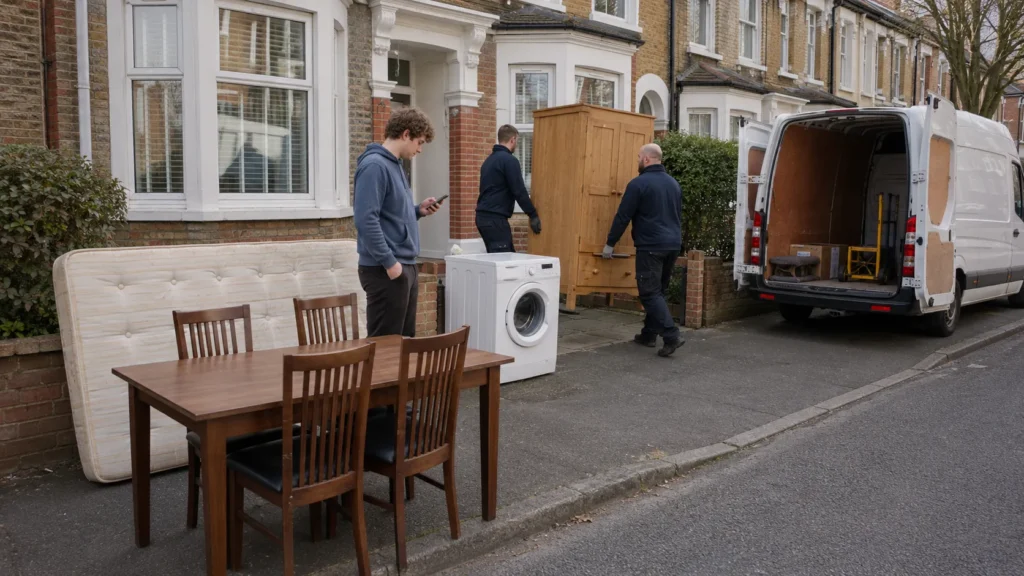
Large household items are rarely suitable for an ordinary wheelie bin. An old sofa, mattress, wardrobe, washing machine or dining table may require a dedicated collection, but Croydon residents have more than one disposal option.
The two main choices are Croydon Council’s bulky waste collection service and a private rubbish removal company.
Both can proCroydon bulky waste collection vs private rubbish removalvide a legitimate way to dispose of unwanted items, but their booking processes, collection conditions, waste restrictions and levels of assistance may differ.
Croydon Council’s service may be suitable for residents with a small number of accepted household items who can prepare and position everything according to the council’s collection rules.
Private rubbish removal may be more practical when lifting is required, waste must be removed from inside a property, several types of rubbish are involved or a more flexible appointment is needed.
This guide compares the two options to help residents make an informed decision.
What Is Croydon Council’s Bulky Waste Collection Service?
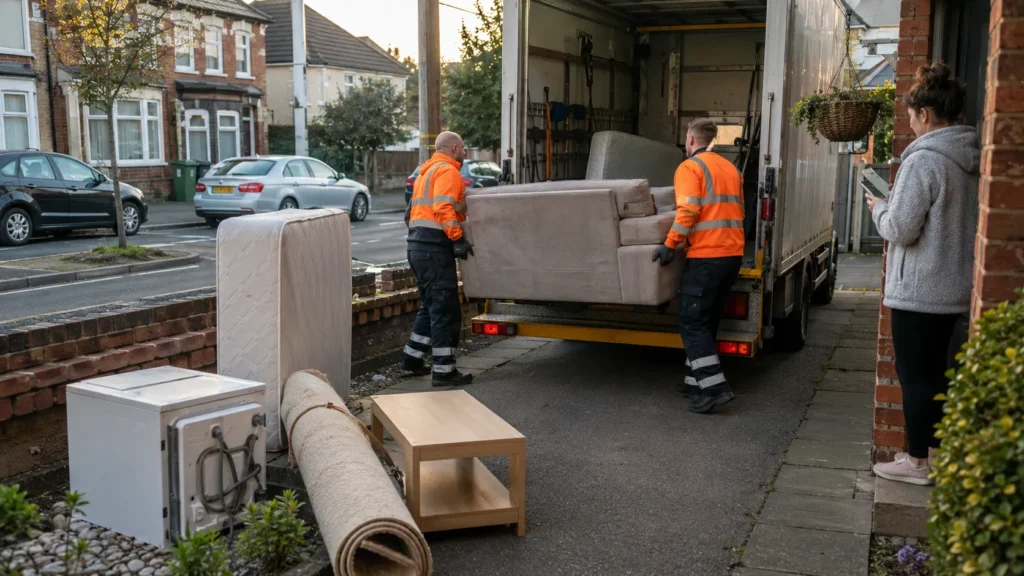
Croydon Council offers a paid collection service for large or unwanted household items that cannot be reused, recycled or transported easily to a household reuse and recycling centre.
Residents use an online form to specify the items, select an available collection date and pay for the service.
The council then sends an email confirming the booking details. Only the items included in the order will be collected.
According to the council’s published terms, a booking can cover up to six bulky items. As of August 2026, the listed charges are:
| Number of items | Council charge |
| One to three items | £40.40 |
| Four to six items | £65.30 |
These prices and conditions may change, so residents should check Croydon Council’s current bulky waste pages before making a decision.
What Items Does Croydon Council Collect?
The council accepts a range of large household items, including:
- Sofas and armchairs
- Beds and mattresses
- Tables and chairs
- Carpets and rugs
- Bicycles and garden furniture
- Televisions, computers and hi-fi equipment
- Fridges, washing machines and other large appliances
- Certain bathroom items, including sinks, toilets and baths
An item must be manageable by no more than two collection workers. Extra items should not be placed alongside a booked collection unless the order has been amended within the permitted period.
Residents should describe each item accurately. A bag, box or bundle can be counted as an individual item, and packaged waste must be secure and capable of being lifted safely.
What Will the Council Not Collect?
The council service is not designed for every type of rubbish. Its exclusions include hazardous waste, some construction materials and items that require a different disposal route.
Examples include:
- Asbestos and chemicals
- Paints and varnishes
- Gas bottles and cylinders
- Tyres
- Glass and mirrors
- Rubble and plasterboard
- Broken tiles
- Earth and soil
- Tree stumps
- Car batteries
- Pianos
- Waterlogged items
Some excluded materials can be taken to an appropriate reuse and recycling centre, returned to a retailer or supplier, or handled through a specialist disposal service. Residents should never mix hazardous materials with an ordinary bulky waste collection.
Where Must Council Collection Items Be Left?
One of the most important differences between the council service and many private collections is the position of the waste.
Croydon Council requires items to be placed together in front of the home, on a driveway or in another easily accessible collection point. Items should normally be put out the night before because collection crews may begin as early as 5am.
Where a property has steps between the home and the public footpath, the items must be moved to pavement level. Residents in blocks of flats are instructed to leave the items outside the bin area.
The waste must not be placed on the public highway and should be no more than 10 metres from where the collection vehicle can stop.
This means the resident generally needs to move the furniture or appliance out of the property before the crew arrives. That may be manageable for a small table or chair, but it can be difficult with a heavy sofa, wardrobe, mattress or washing machine.
How Does Private Rubbish Removal Work?
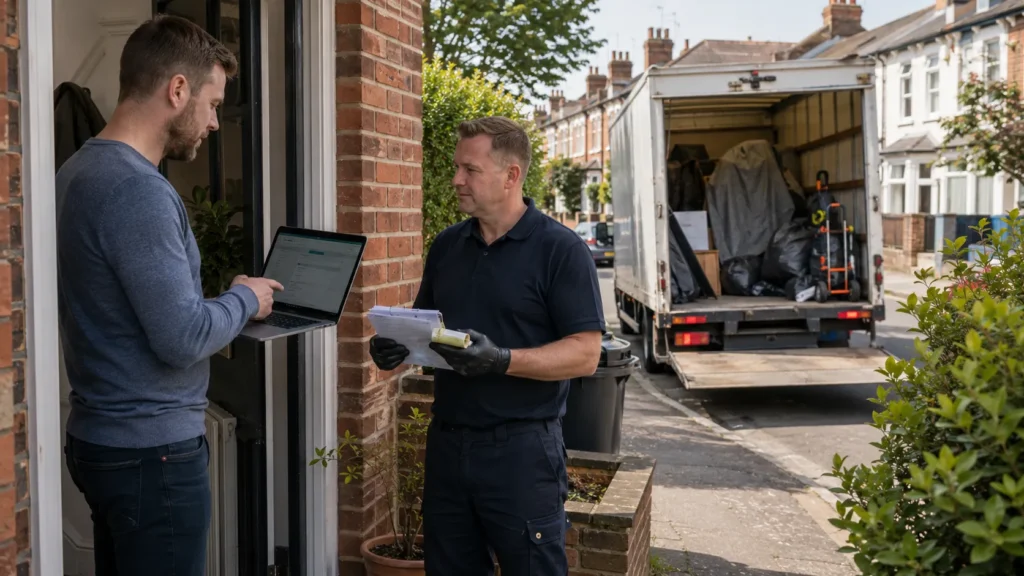
A private clearance company usually assesses the waste before confirming a quotation. Customers may be asked to provide photographs, the collection postcode, a list of items and information about stairs, lifts, parking and access.
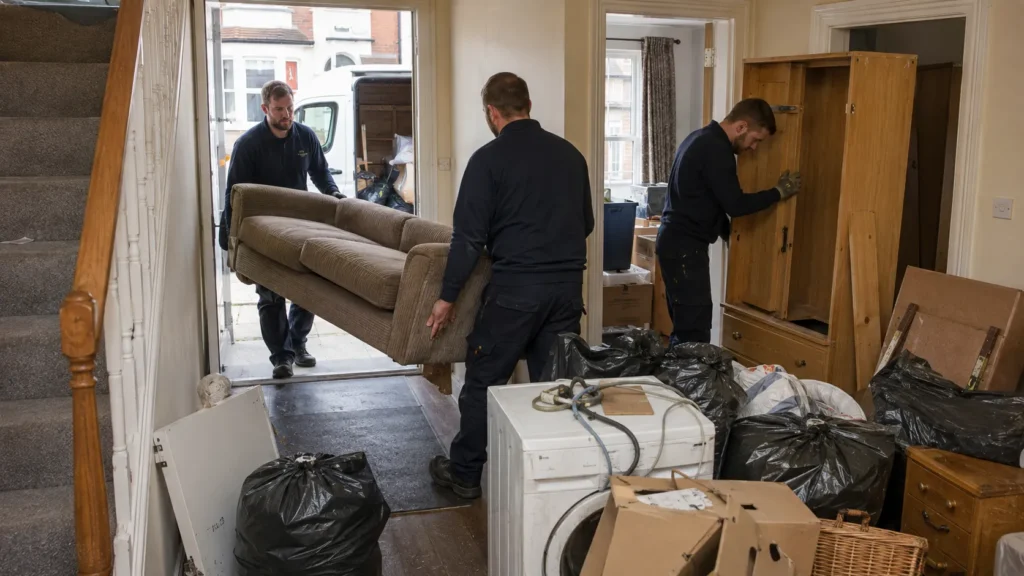
Depending on the company and agreed service, a collection team may enter the property, lift the items, carry them through hallways or communal areas, load the vehicle and transport the waste to an authorised facility.
For residents who cannot move heavy items outside, private rubbish removal in Croydon may therefore provide a more convenient option.
However, services vary between operators. Customers should confirm exactly what is included in the quotation, whether dismantling is available, what materials can be accepted and whether any additional charges could apply.
Council Collection vs Private Rubbish Removal
The most suitable choice depends on the amount of waste, its location, the type of materials and how quickly the property needs to be cleared.
| Consideration | Croydon Council collection | Private rubbish removal |
| Type of service | Scheduled household bulky-item collection | Quoted clearance service |
| Item limit | Up to six items per visit | Depends on vehicle capacity and quotation |
| Waste location | Items must be placed at the specified external collection point | Internal collection may be available |
| Lifting from inside | Not part of the standard collection arrangement | Often available when agreed |
| Collection dates | Selected from council availability | Depends on the company’s availability |
| Same-day service | Not stated as a standard option | May be offered by some companies |
| Construction waste | Not accepted | Some non-hazardous builders’ waste may be accepted |
| Commercial waste | Household service conditions apply | Commercial collections may be available |
| Pricing | Published charge based on item bands | Individual quotation |
| Additional items | Only booked items are collected | Can be reassessed before loading |
The comparison does not mean one option is always better. Each service is designed for different circumstances.
When Is Croydon Council Collection Likely to Be Suitable?
The council service may be a practical choice when:
- The waste consists of one to six accepted household items.
- The items can be moved safely to the required outdoor location.
- The resident can wait for an available collection date.
- No dismantling or internal lifting is required.
- The booking can be completed accurately in advance.
- The customer is comfortable following the council’s preparation rules.
For example, a resident replacing a mattress and a small dining table may find the council service straightforward if both items can be placed outside safely before collection.
When Might Private Rubbish Removal Be More Suitable?
A private company may be more appropriate when:
- Heavy items must be carried from inside the property.
- The collection involves stairs, lifts or restricted access.
- A house, flat, garage, loft or office requires a wider clearance.
- More than six items need to be removed.
- Furniture needs to be dismantled before removal.
- Several categories of non-hazardous waste are involved.
- The collection is connected to a tenancy deadline, house move or refurbishment.
- A faster or more flexible appointment is required.
Private clearance can also help landlords, letting agents and businesses whose needs may fall outside the scope of a standard household bulky-item service.
What About Taking Items to a Recycling Centre?
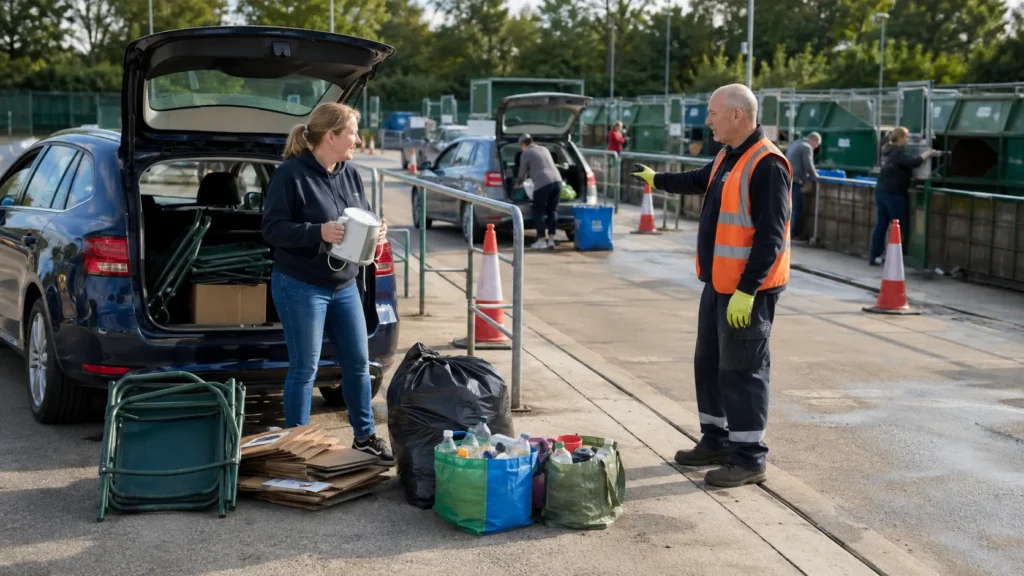
Residents with suitable transport may be able to take certain materials to one of Croydon’s household reuse and recycling centres.
The council states that its sites accept recyclable materials alongside household waste in black bags, garden waste, small electrical goods and small bulky items.
Materials should be sorted before arrival. The sites do not accept asbestos, chemicals, gas bottles, paints, varnishes or tyres.
Before travelling, residents should check the current opening hours, vehicle restrictions, permit requirements and accepted-material rules for the chosen site.
Taking items to a recycling centre may reduce collection costs, but it requires an appropriate vehicle and the physical ability to load and unload the waste safely.
How Can Residents Check a Private Waste Collector?
Householders have a legal duty to take reasonable steps to ensure their waste is passed to an authorised person.
Before using a private company, the customer should check that the operator has a valid upper-tier waste carrier registration. Registrations can be checked through the Environment Agency’s public register using the company name, postcode or registration number.
It is also sensible to retain evidence of the collection, such as a receipt, quotation, registration details and the vehicle registration number.
These records may help demonstrate that reasonable checks were completed if the waste is subsequently found fly-tipped.
Customers should be cautious when an operator:
- Refuses to provide business or registration details
- Offers to remove waste anonymously for cash
- Cannot explain where the rubbish will be taken
- Uses an unsuitable or unsecured vehicle
- Provides no written quotation or receipt
- Offers a price that appears unrealistically low
The cheapest offer is not necessarily the safest or most responsible option.
Which Option Should Croydon Residents Choose?
Croydon Council bulky waste collection is likely to suit residents disposing of a limited number of accepted household items that can be moved to the required outdoor collection point.
Private rubbish removal may suit customers who need lifting, loading, internal clearance, multiple waste types or greater scheduling flexibility.
It can also be more appropriate for landlords, offices, builders and residents clearing larger quantities.
Before booking either service, the customer should identify every item, check whether it is accepted, consider access to the property and confirm the full cost. Where a private company is used, its waste carrier registration should be verified.
The right option is the one that can remove the waste safely, lawfully and practically while meeting the customer’s access, timing and collection requirements.
Croydon Council Bulky Waste Collection vs Private Rubbish Removal: Which Should You Choose?
Large household items are rarely suitable for an ordinary wheelie bin. An old sofa, mattress, wardrobe, washing machine or dining table may require a dedicated collection, but Croydon residents have more than one disposal option.
The two main choices are Croydon Council’s bulky waste collection service and a private rubbish removal company.
Both can provide a legitimate way to dispose of unwanted items, but their booking processes, collection conditions, waste restrictions and levels of assistance may differ.
Croydon Council’s service may be suitable for residents with a small number of accepted household items who can prepare and position everything according to the council’s collection rules.
Private rubbish removal may be more practical when lifting is required, waste must be removed from inside a property, several types of rubbish are involved or a more flexible appointment is needed.
This guide compares the two options to help residents make an informed decision.
What Is Croydon Council’s Bulky Waste Collection Service?
Croydon Council offers a paid collection service for large or unwanted household items that cannot be reused, recycled or transported easily to a household reuse and recycling centre.
Residents use an online form to specify the items, select an available collection date and pay for the service.
The council then sends an email confirming the booking details. Only the items included in the order will be collected.
According to the council’s published terms, a booking can cover up to six bulky items. As of August 2026, the listed charges are:
| Number of items | Council charge |
| One to three items | £40.40 |
| Four to six items | £65.30 |
These prices and conditions may change, so residents should check Croydon Council’s current bulky waste pages before making a decision.
What Items Does Croydon Council Collect?
The council accepts a range of large household items, including:
- Sofas and armchairs
- Beds and mattresses
- Tables and chairs
- Carpets and rugs
- Bicycles and garden furniture
- Televisions, computers and hi-fi equipment
- Fridges, washing machines and other large appliances
- Certain bathroom items, including sinks, toilets and baths
An item must be manageable by no more than two collection workers. Extra items should not be placed alongside a booked collection unless the order has been amended within the permitted period.
Residents should describe each item accurately. A bag, box or bundle can be counted as an individual item, and packaged waste must be secure and capable of being lifted safely.
What Will the Council Not Collect?
The council service is not designed for every type of rubbish. Its exclusions include hazardous waste, some construction materials and items that require a different disposal route.
Examples include:
- Asbestos and chemicals
- Paints and varnishes
- Gas bottles and cylinders
- Tyres
- Glass and mirrors
- Rubble and plasterboard
- Broken tiles
- Earth and soil
- Tree stumps
- Car batteries
- Pianos
- Waterlogged items
Some excluded materials can be taken to an appropriate reuse and recycling centre, returned to a retailer or supplier, or handled through a specialist disposal service. Residents should never mix hazardous materials with an ordinary bulky waste collection.
Where Must Council Collection Items Be Left?
One of the most important differences between the council service and many private collections is the position of the waste.
Croydon Council requires items to be placed together in front of the home, on a driveway or in another easily accessible collection point. Items should normally be put out the night before because collection crews may begin as early as 5am.
Where a property has steps between the home and the public footpath, the items must be moved to pavement level. Residents in blocks of flats are instructed to leave the items outside the bin area.
The waste must not be placed on the public highway and should be no more than 10 metres from where the collection vehicle can stop.
This means the resident generally needs to move the furniture or appliance out of the property before the crew arrives.
That may be manageable for a small table or chair, but it can be difficult with a heavy sofa, wardrobe, mattress or washing machine.
How Does Private Rubbish Removal Work?
A private clearance company usually assesses the waste before confirming a quotation. Customers may be asked to provide photographs, the collection postcode, a list of items and information about stairs, lifts, parking and access.
Depending on the company and agreed service, a collection team may enter the property, lift the items, carry them through hallways or communal areas, load the vehicle and transport the waste to an authorised facility.
For residents who cannot move heavy items outside, private rubbish removal in Croydon may therefore provide a more convenient option.
However, services vary between operators. Customers should confirm exactly what is included in the quotation, whether dismantling is available, what materials can be accepted and whether any additional charges could apply.
Council Collection vs Private Rubbish Removal
The most suitable choice depends on the amount of waste, its location, the type of materials and how quickly the property needs to be cleared.
| Consideration | Croydon Council collection | Private rubbish removal |
| Type of service | Scheduled household bulky-item collection | Quoted clearance service |
| Item limit | Up to six items per visit | Depends on vehicle capacity and quotation |
| Waste location | Items must be placed at the specified external collection point | Internal collection may be available |
| Lifting from inside | Not part of the standard collection arrangement | Often available when agreed |
| Collection dates | Selected from council availability | Depends on the company’s availability |
| Same-day service | Not stated as a standard option | May be offered by some companies |
| Construction waste | Not accepted | Some non-hazardous builders’ waste may be accepted |
| Commercial waste | Household service conditions apply | Commercial collections may be available |
| Pricing | Published charge based on item bands | Individual quotation |
| Additional items | Only booked items are collected | Can be reassessed before loading |
The comparison does not mean one option is always better. Each service is designed for different circumstances.
When Is Croydon Council Collection Likely to Be Suitable?
The council service may be a practical choice when:
- The waste consists of one to six accepted household items.
- The items can be moved safely to the required outdoor location.
- The resident can wait for an available collection date.
- No dismantling or internal lifting is required.
- The booking can be completed accurately in advance.
- The customer is comfortable following the council’s preparation rules.
For example, a resident replacing a mattress and a small dining table may find the council service straightforward if both items can be placed outside safely before collection.
When Might Private Rubbish Removal Be More Suitable?
A private company may be more appropriate when:
- Heavy items must be carried from inside the property.
- The collection involves stairs, lifts or restricted access.
- A house, flat, garage, loft or office requires a wider clearance.
- More than six items need to be removed.
- Furniture needs to be dismantled before removal.
- Several categories of non-hazardous waste are involved.
- The collection is connected to a tenancy deadline, house move or refurbishment.
- A faster or more flexible appointment is required.
Private clearance can also help landlords, letting agents and businesses whose needs may fall outside the scope of a standard household bulky-item service.
What About Taking Items to a Recycling Centre?
Residents with suitable transport may be able to take certain materials to one of Croydon’s household reuse and recycling centres.
The council states that its sites accept recyclable materials alongside household waste in black bags, garden waste, small electrical goods and small bulky items.
Materials should be sorted before arrival. The sites do not accept asbestos, chemicals, gas bottles, paints, varnishes or tyres.
Before travelling, residents should check the current opening hours, vehicle restrictions, permit requirements and accepted-material rules for the chosen site.
Taking items to a recycling centre may reduce collection costs, but it requires an appropriate vehicle and the physical ability to load and unload the waste safely.
How Can Residents Check a Private Waste Collector?
Householders have a legal duty to take reasonable steps to ensure their waste is passed to an authorised person.
Before using a private company, the customer should check that the operator has a valid upper-tier waste carrier registration.
Registrations can be checked through the Environment Agency’s public register using the company name, postcode or registration number.
It is also sensible to retain evidence of the collection, such as a receipt, quotation, registration details and the vehicle registration number.
These records may help demonstrate that reasonable checks were completed if the waste is subsequently found fly-tipped.
Customers should be cautious when an operator:
- Refuses to provide business or registration details
- Offers to remove waste anonymously for cash
- Cannot explain where the rubbish will be taken
- Uses an unsuitable or unsecured vehicle
- Provides no written quotation or receipt
- Offers a price that appears unrealistically low
The cheapest offer is not necessarily the safest or most responsible option.
Which Option Should Croydon Residents Choose?
Croydon Council bulky waste collection is likely to suit residents disposing of a limited number of accepted household items that can be moved to the required outdoor collection point.
Private rubbish removal may suit customers who need lifting, loading, internal clearance, multiple waste types or greater scheduling flexibility.
It can also be more appropriate for landlords, offices, builders and residents clearing larger quantities.
Before booking either service, the customer should identify every item, check whether it is accepted, consider access to the property and confirm the full cost. Where a private company is used, its waste carrier registration should be verified.
The right option is the one that can remove the waste safely, lawfully and practically while meeting the customer’s access, timing and collection requirements.